
Attachment therapy
Relationships have been hard. Let’s restore the magic and connection you’ve been longing for.

Attachment therapy helps you understand and heal the relational wounds that shape how you connect with yourself and others. If you've spent years feeling like something is off in your relationships, like you're always the one doing the heavy lifting, accommodating, shapeshifting to maintain connection, you're not broken. You learned to survive. And now, you're ready to do more than survive.
You've probably noticed patterns that keep repeating. You keep meeting the same type of partner. You struggle with the same issues again and again. Maybe you are hyper independent and can’t stomach asking for help. Support - What’s that? Maybe you go into a panic at any sign of conflict, upset, or possible separation. Perhaps you ignore your own needs, sacrificing yourself again and again, only to feel depleted, resentful, and angry that others don’t notice and won’t do the same. Attachment therapy helps you trace these patterns back to their roots, not to assign blame, but to finally understand why your nervous system responds the way it does and to build new pathways toward secure, nourishing connection.
The Roots Run Deep
The way you learned to attach was shaped long before you had words for any of it. Your earliest relationships created a blueprint for how you navigate intimacy, conflict, vulnerability, and even your relationship with yourself. It was necessary and wise.
Maybe you grew up where love came with conditions, where you learned to read the room before you could read books, where being "good" meant suppressing your own needs to keep the peace. Perhaps you were parentified, thrust into the role of caretaker or emotional regulator for adults who should have been caring for you. These early experiences became encoded in your body, your nervous system, and your automatic responses to connection.
For a long time, your survival strategies actually worked. Accommodating kept you safe. Shapeshifting maintained connection. Working harder than everyone else earned you a place at the table. But strategies that once protected you eventually become the very things that keep you stuck. The constant self-abandonment that kept peace in your childhood home now leaves you resentful and depleted. The mask you wore to be acceptable has become so fused to your face that you've lost touch with who you actually are underneath.
How I Work
In my practice, attachment therapy isn't about sitting across from each other while you do all the work of figuring out what's wrong with you. That would just replicate the old dynamic.
Instead, we dance together. I work alongside you. I'm engaged, interactive, super curious and deeply attuned to what's happening between us in the present moment. The therapeutic relationship itself becomes a living laboratory where old patterns can surface, be witnessed, and gradually shift. When you express a need and it's met with warmth instead of dismissal, when you show up authentically messy and find that connection remains, these become corrective experiences that rewire your attachment system at its foundation. I’m also human and am going to be imperfect and make mistakes. When this happens, we are going to acknowledge, meet, and repair. Wounds in relationship must be healed in relationship . . . which sometimes sucks, but is a truth I’ve lived in over and over again.
I draw on somatic therapy, dance/movement therapy, parts work through a relational neuroscience lens, therapeutic writing, and authentic movement.
We're not just talking about your experiences. We're working with the body that holds them.
We all crave connection (even if we have parts that say otherwise). We are neurobiologically wired to connect - and when early relational experiences have started off wonky, confusing, scary, or with people who have also been wounded (this is actually all of us to differing levels) - our attachment system springs into action. It knows exactly how to restore connection - whether that means screaming a little louder for attention or shutting down when our needs might overwhelm a caregiver.
Without a second thought, our bodies, brains, spirits, and nervous systems take charge to make sure we act in ways that will keep people close enough. This is why I know without a doubt, that your system is always reaching towards health. I trust that whatever symptom, behavior, or reaction is showing up has a very good reason for being there. Your anxiety isn't random. It's information. Your walls aren't weakness. They're protection that has served you well.
The Paradox of This Work
I alluded to this above . . . but here is the elephant in the room, the truth that no one wants to hear. When we’ve been hurt in relationships, we have to heal in relationships. Because as relatively vulnerable human beings, without giant teeth and sharp claws to keep us protected and alive - we need connection. Especially when we are little - we can’t survive without being connected to a bigger more capable adult. As we are totally dependent on this to live, we learn exactly what it takes to keep this person around - no matter the cost to ourselves. This is the worst (and the best) - because it means you chose life! You made it! It also means your relationship with yourself has been hurt along the way.
The unfortunate consequence is that being in relationship is going to stir up all the hard and scary stuff, the injuries, the festering pains, the unmet needs. BUT now, in the present moment, with your full grown adult self and my full grown adult self, we have the chance to do things differently. Yes, things are going to get activated. It might even hurt. And . . .if we lean in, slow down, and tend to these wounds with deep presence and so much care - we have the chance to do something different. This will give you a choice, more freedom, and option whereas before the only program running was survival.
So - the paradox is really this: there are parts of yourself that you really love and want to be more connected. They will be easy to welcome in and celebrate. There are also parts you hate, are going to want to avoid like the plague, hide from view, and deny their very existence. You aren’t going to want to accept, welcome, or even give them an invitation. And yet . . .we must if you are interested in feeling whole, alive, and intend to know safety, connection, magic and goodness in relationships. We start by recognizing when your inner world is in conflict. Seeing when the striving itself has become the problem - not because it is bad, but because the striving keeps you away from the rage that feels like it will explode if you stop. The rage gets rage-ier as it feels unheard, alone, and is forced to either get louder or show up in a different way - think chronic pain, migraine, endless self blame and criticism, which then activates even more striving. You are good at punishing yourself into compliance, blaming, pushing, doing to yourself exactly what was once done to you.
Together we will build capacity to rest, to receive, to let someone else hold space for you without immediately trying to earn it. To tolerate, accept, and perhaps eventually appreciate all the parts of you - good, bad, messy, and otherwise. It means letting your nervous system learn that safety doesn't require constant vigilance and that pleasure, ease, and rest can be places you're allowed to land.





What to Expect
I offer both online sessions and in-person sessions in Layton, UT. We begin with a free consultation, a chance for us to meet and sense whether this feels like a good fit.
If we decide to move forward, I ask for a commitment to three initial sessions. During this time, we'll get to know each other and you'll get a feel for what it’s like to be in relationship with me and how we might work together. At the end of these three sessions, we decide together whether to continue. If it's a yes, we'll schedule regular weekly sessions, with an option to move bi-weekly after 6 months.
Throughout our work, I check in regularly about what's working and what isn't. Your healing path is yours, and our work together should reflect that. What better way to practice speaking honestly, repairing missteps, saying “no” instead of yes, and learning to work together in a relationship that can tolerate and welcome all of you?
You've Carried This Long Enough
You've spent years carrying weight that was never yours to carry. You've accommodated, adapted, and abandoned yourself in service of maintaining connections that asked too much and gave too little.
What if you didn't have to carry it alone anymore? What if there was a space where all of you could show up and be met with warmth, curiosity, and genuine presence? That space is Spirals & Heartspace, and it is here when you are ready.
The fear of staying the same is greater than the fear of change. You already know this, or you wouldn't still be reading.
Contact me today to schedule your free consultation and learn more about how attachment therapy can support your journey toward reclaiming yourself.
Located at:
Layton, UT
Frequently Asked Questions About Attachment Therapy

-
Attachment therapy specifically focuses on healing relational wounds from your earliest relationships. Unlike traditional talk therapy that primarily works with thoughts, attachment therapy works with your nervous system and body, recognizing that attachment patterns were formed before language and often need more than words to shift.
-
Common signs include anxiety when others don't respond quickly, difficulty trusting people will stay, patterns of over-giving or people-pleasing, feeling responsible for others' emotions, and a persistent sense that something is wrong with you even when relationships look fine on the outside.
-
Yes. Our brains remain capable of forming new neural pathways throughout life. While you can't change what happened in childhood, you can develop "earned secure attachment" through corrective relational experiences in therapy.
-
Meaningful change often begins within several months of consistent sessions, though deeper transformation unfolds over a year or more. I honor your unique pace rather than rushing toward a predetermined endpoint.
-
Probably not. Most likely the relationship that will improve the most is the one you have with yourself. Ironically - this is also the one that matters the most. Because once we start appreciating, knowing, and welcoming our whole selves, we stop tolerating relationships with others that don’t feel good. Instead of putting up with people who are OK to underfunction while you overfunction, or who you allow to treat you poorly because you understand their trauma - you stop because it doesn’t feel good. Some relationships will get stronger, fuller, and deeper, while others will fall away and end.
-
Your attachment patterns live in your body as tension, bracing, or nervous system activation. I incorporate somatic therapy, dance/movement therapy, and authentic movement to work directly with these embodied patterns.I also use my body and the information I’m getting as we are together. This is a nod to all the ways we communicate nonverbally now and as little ones, so we can find our unique co-regulating dance to support your ability to find more balance inside.
-
Absolutely. Losing a parent with whom you had a tangled relationship brings up the loss itself plus accumulated hurt, role reversals, and protective strategies. Attachment therapy provides space to hold this complexity while reclaiming parts of yourself.
-
Attachment wounds don't require dramatic abuse. They develop from subtle experiences: emotional unavailability, suppressing needs to keep peace, or not having your inner experience consistently validated. Your struggles are valid regardless of how things looked from outside.
-
Parts work helps us understand that your psyche contains different parts, each developed for good reasons. Rather than eliminating these parts, we build relationships with them, understand their protective intentions, and help them update their strategies.
-
Sessions may bring relief, grief, anger, or fear as old defenses soften. Some sessions feel like breakthroughs; others feel like steady work. Between sessions, you might notice more awareness of your patterns in daily life.
-
I offer a free consultation so we can both sense whether working together feels right. I'm a good fit for people ready to go deep, willing to work with the body as well as the mind, and who want a therapist who's engaged rather than a blank slate.
Getting started
We'll begin with a free consultation to chat and see if we're a good fit. If it feels right, we'll schedule three sessions to get to know each other and give you a real taste of this work. After that, we'll decide together if continuing makes sense, typically with weekly or bi-weekly sessions.
Curious about scheduling or investment? Reach out. I'm happy to answer your questions. I'd be truly honored to walk alongside you on this journey home to yourself.
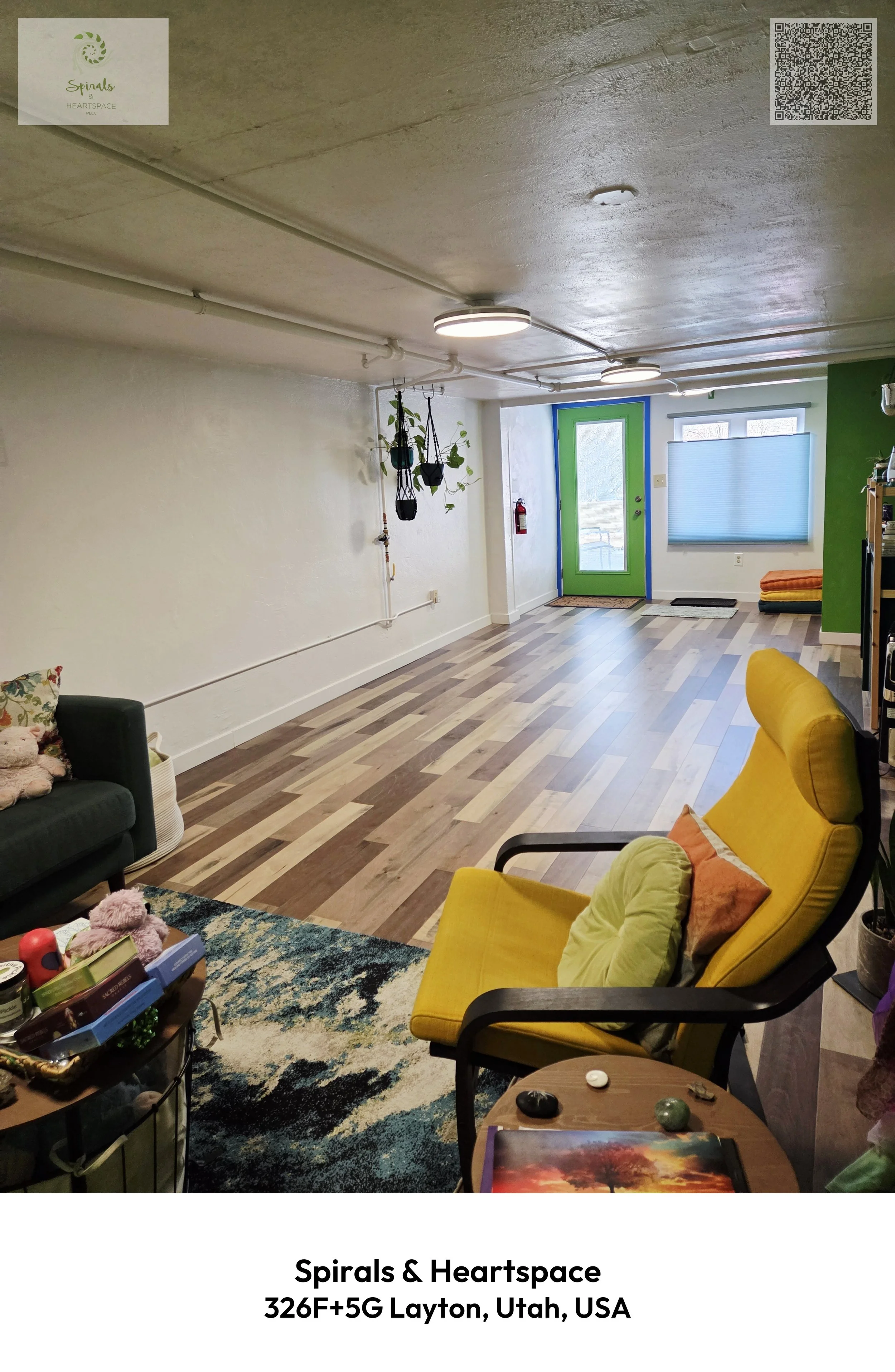
Located in Layton, UT, Spirals & Heartspace is a somatic-based therapy and coaching practice founded by Ande Welling. The practice focuses on trauma, attachment, and nervous system health using an integrative approach that includes Expressive Arts and Authentic Movement. Catering to those ready to break cycles of confusion and anxiety, Ande offers a mix of therapeutic sessions, professional consultation, and coaching options designed to align clients with their true purpose and inner wisdom.